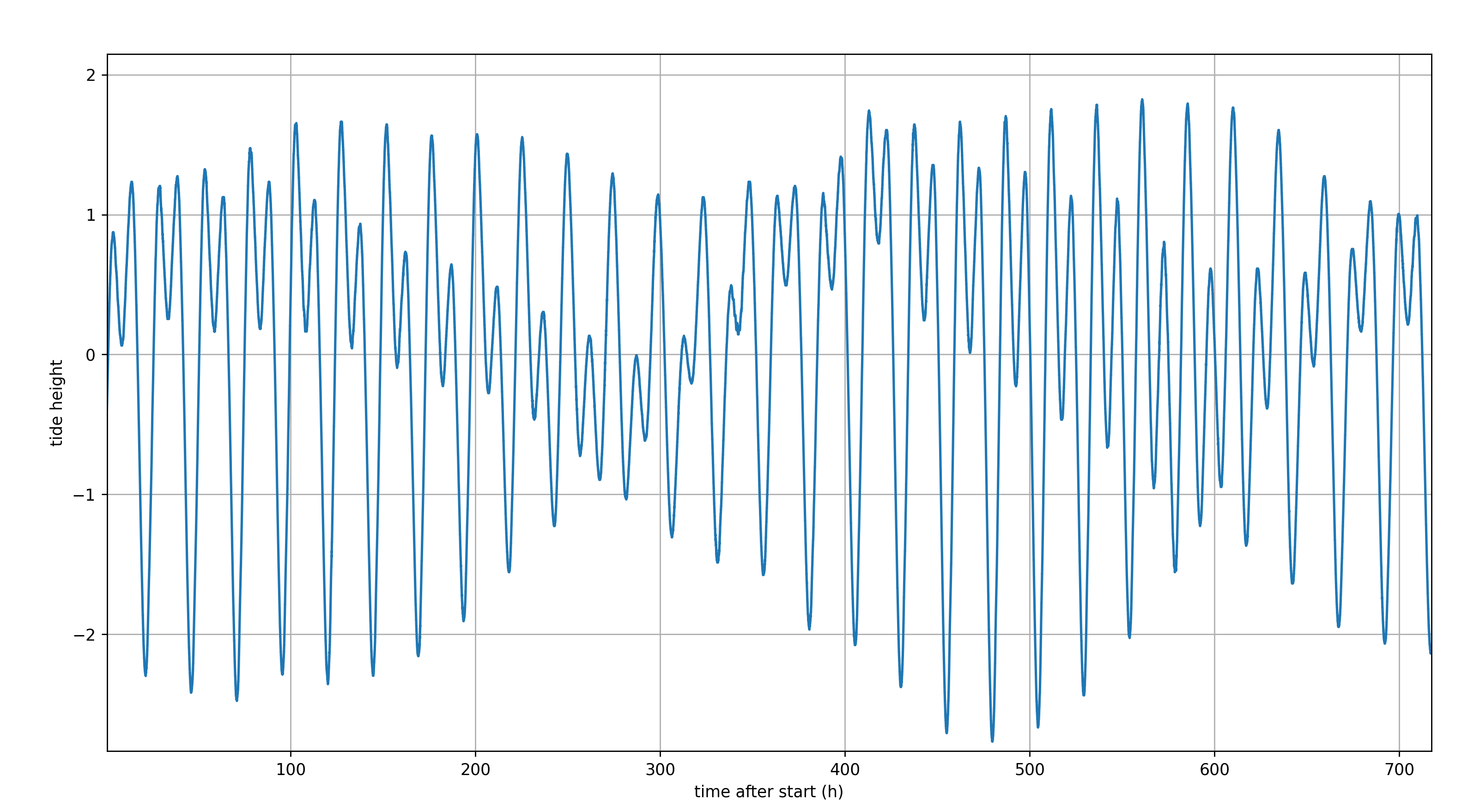
As is widely known, the motion is the tides is a direct result of the gravitational effects of nearby celestial bodies, such as the Sun and Moon. The periodic nature of the orbits of these bodies, and thus that of the tides, means that a Fourier transform algorithm can be very helpful when analysing their motion. Such a Fourier transform allows the complex wave that is tidal heigh vs time (pictured right), to be split apart into its component frequencies. These frequencies are associated with the orbital periods of the Sun and Moon, along with other more complex attributes such as declination. In late 2023 I wrote a discrete Fourier transform algorithm in Python with the goal of using it for this purpose.
Tidal Height vs. Time
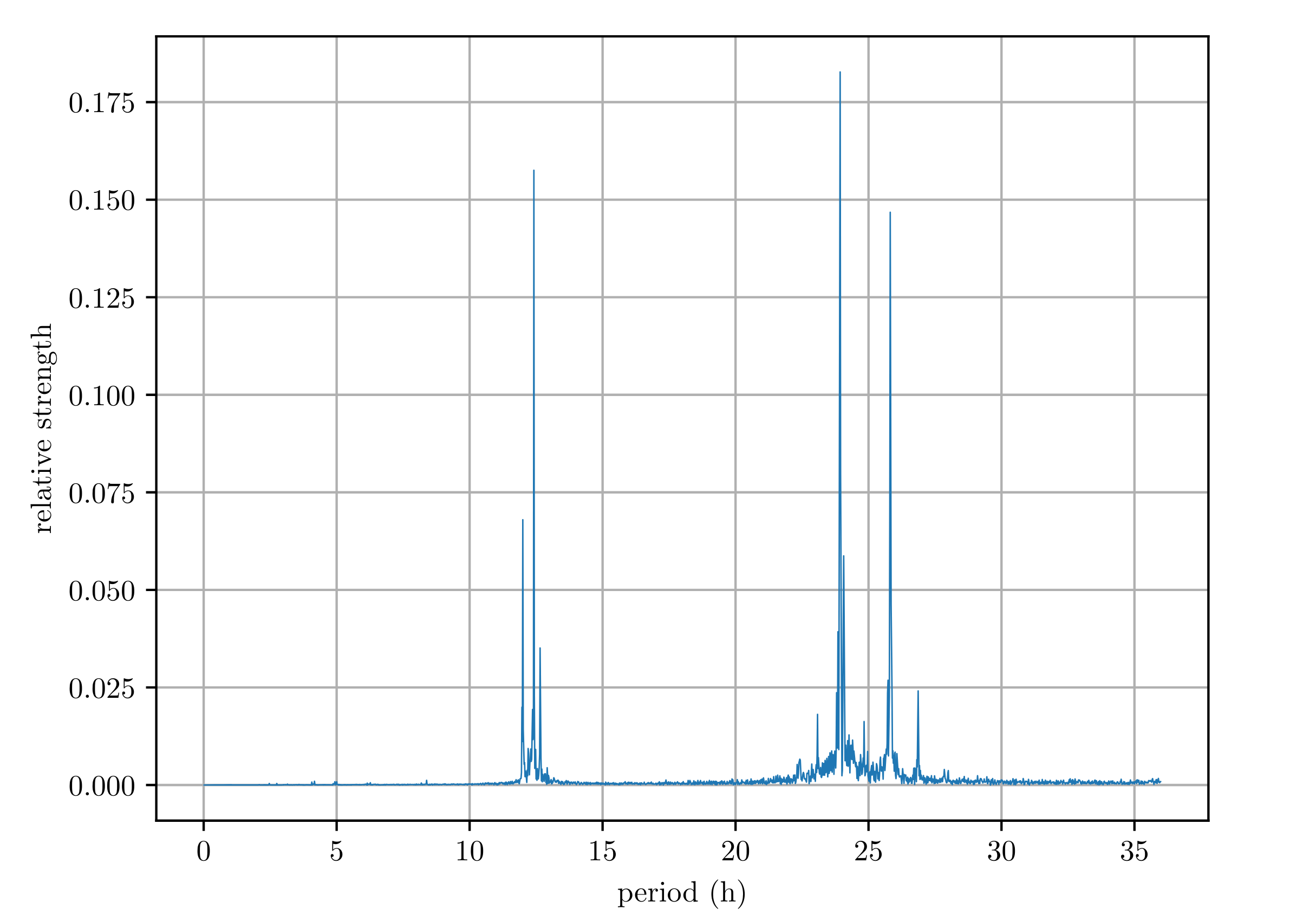
The program I wrote was a regular discrete Fourier transform that was a function of period instead of frequency. This made it easier to relate the peaks to orbital periods of nearby celestial bodies. As this project predated most of my understanding of complex numbers I used trig functions to represent them according to Euler's identity. Pictured below is the output of my Fourier transform algorithm when used on five years worth of minutely tidal data from Waterfront seabus station in Vancouver.
The following table shows some of the stronger peaks with their period and relative strength:
Period (h)
Relative Strength
23.93
0.183
12.42
0.158
25.82
0.147
12.00
0.068
24.07
0.059
12.65
0.035
26.86
0.024
These frequencies all correspond to the motion of nearby celestial bodies. Some of the relationships are intuitive, for example the 12 hour one corresponds to the time it takes for a point on the Earth to go from facing the Sun to facing away from the Sun. The 12.42 hour peak is the time it takes for a point on the Earth to go from facing the Moon to facing away from the Moon, keeping in mind that the moon is orbiting the Earth in the same direction as the Earth spins. Others are less obvious, for example the strongest peak, with a 23.93 hour period, actually corresponds to the declination of the moon (the angle between the Moon's orbital axis and the Earth's). This effect pulls each of the tidal bulges to the North and South over the course of a month resulting in a "beating" in the amplitude of the tides. This beating is expressed in the Fourier transform as two separate frequencies adding together, much like how when two musicians play two slightly different notes a beating sound can be heard.