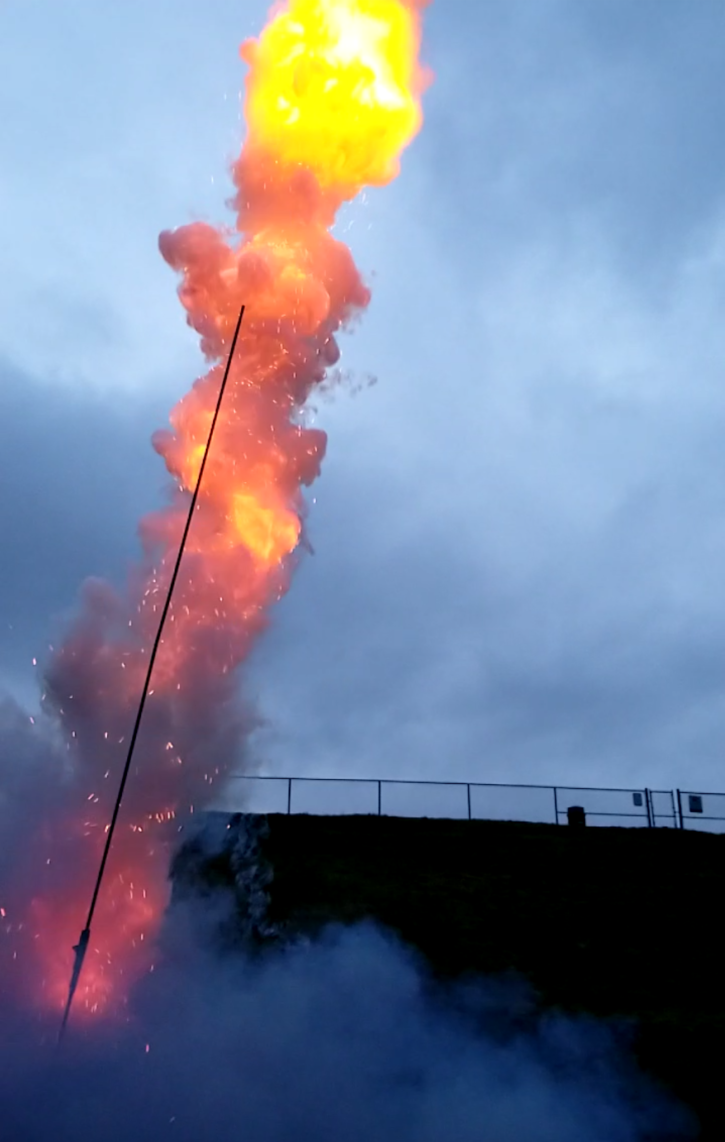
Fig. 1: A particulately exciting attempted launch!
In early 2020 my good friend Ronny and I started trying to build solid rocket motors from scratch using widely available chemicals. Afer numerous redesigns with several different types of propellant we succeeded in creating a flying prototype in 2022, with models eventually reaching altitudes of over 125m.
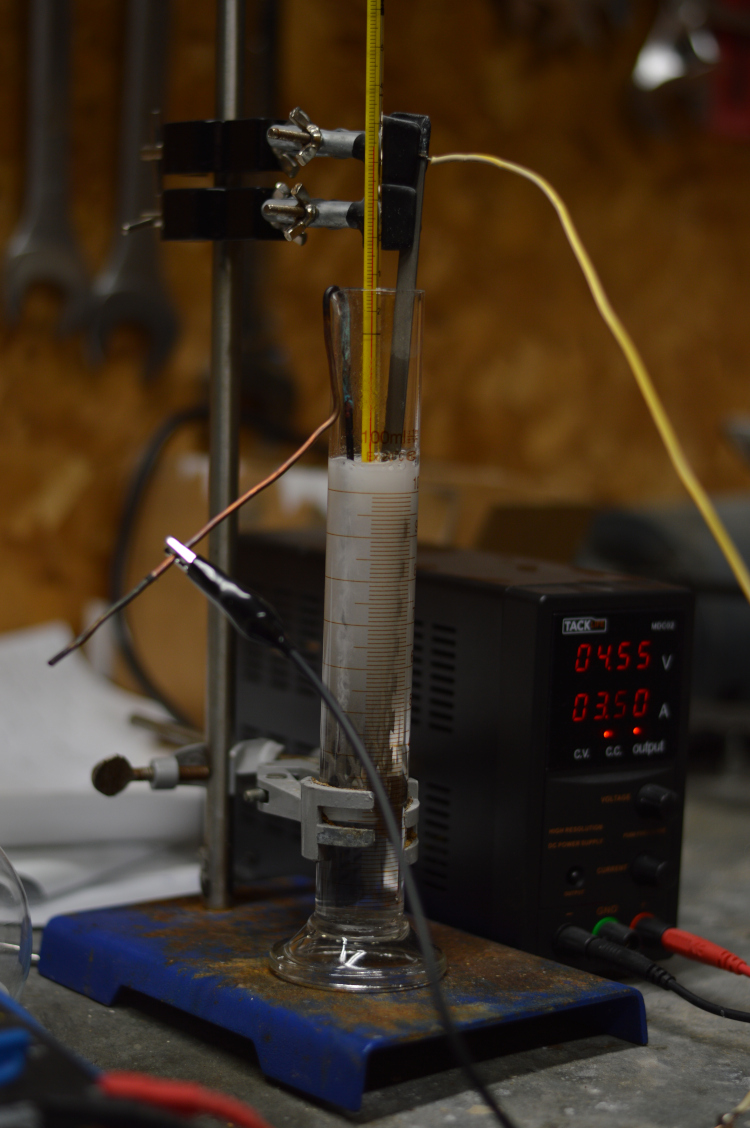
Getting the oxidizers needed for the propellant was one of the bigger challenges involved with this project. We started out using potassium chlorate because we could make it from potassium chloride using electrolysis. To do so we used a platinum coated titanium mesh anode purchased online, and a copper cathode. These were then submerged in a saturated aqueous solution of potassium chloride and powered with 5V.
As potassium chlorate is much less soluble than potassium chloride the chlorate precipitates out as it forms, and it can be collected by decanting/filtering the electrolyte. After purification by recrystallization we were able to collect a few hundred grams of potassium chlorate per week of running the cell.
We also made some potassium perchlorate by thermal disproportionation of the potassium chlorate into perchlorate and chloride. The chloride was then separated out with recrystallization in water. We tested a few perchlorate rocket motors but this process ended up being too work intensive to really be practical.
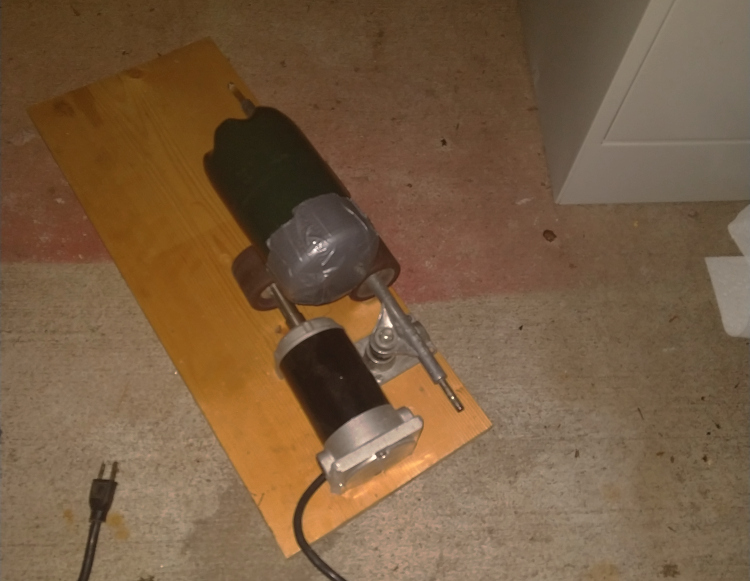
Many high performance rocket propellants use aluminum powder to achieve better specific impulses. To make aluminum power for our fuels I made a ball mill using some skateboard wheels, a propane tank, and a motor (see Fig. 3). This ball mill could turn shredded aluminum foil into power fine enough that it could be lit with a match.
For fuels we experimented with sugar, charcoal, and aluminum powder. We also sometimes added binder (silicone caulk or dextrose) so that the fuel could be shaped inside the combustion chamber. The charcoal was made by heating wood inside a paint tin with a hole in the lid over a fire.
Potassium nitrate is a much more stable oxidizer than potassium chlorate, meaning that propellants using nitrate are much less likely to cause explosions. As our chlorate based propellants seemed to have this problem we decided to try with potassium nitrate instead.
To make the potassium nitrate we did a double displacement reaction between calcium nitrate fertilizer and potassium chloride water softener salt. This made potassium nitrate and calcium chloride, the later of which is quite soluble in water so it could be separated by recrystallization. As calcium chloride is very hydroscopic we would usually do three recrystallizations to make sure we got it all.
We tried various construction materials for the rockets, . We found in the end that paper mâché tubes ended up being the best material for us to make our rocket bodies out of as it was light, inexpensive, and wouldn't produce dangerous fragments in the event of an explosion. We would make these by wrapping wheat paste soaked newspaper strips around a metal dowel and then drying them in the oven.
The nozzle was made from ground bentonite clay (from kitty litter) and wax. We 3D printed a jig to press this clay into the shape of a nozzle at the end of the tube. The jig could then be used to pack the propellant into the tube as well, ensuring that it ended up with a cylindrical "grain" in the centre, such that the burn would start in the middle of the tube and work it's way to the edges. This also had the effect of insulating the walls of the tube from the burn.
We 3D printed nose cones for the rockets and made the fins from cardboard. We also glued a piece of drinking straw to the outside of the rockets so that they could be launched from a wire sticking out of the ground, allowing them to reach a high enough speed that the fins would stabilize them before leaving reaching the end of the wire.
When we were still in the process of getting the motors to burn consistently we did a lot of static testing. We would hide on one side of a shipping container on our school's field while using a car battery and home made igniter to ignite the motors on the other side of the box.
Once we got working motors we started flying our prototypes. We would go to a park with lots of soccer fields near our house and launch the rockets using the wire described earlier. We occasionally used fuses from this, made from soaking a mix of charcoal, dextrin, potassium chlorate, and water into a cotton string and then letting it dry.
Our most successful rocket were able to reach altitudes of over 125m, measured using the time delay in video footage at near apogee.